
Why Harder Training Isn’t Better Training
When intensity works against you and how to use it properly
There is a established trend in the fitness space to prescribe training to women based on their stage of life and hormone status, and it is presented as tailored, evidence-based advice. It shows up in simple, confident directives about what women should be doing: “lift heavy sh*t”, “HIIT training is superior to Zone 2”.
The reality is, that isn’t how good training is actually written, at least not by knowledgeable trainers and coaches.
Gender, hormones, and stage of life definitely influence a variety of things including load tolerance, recovery capacity and degree and magnitude of training adaptation, but they do not change the fundamental principles of how good training is structured. Programming decisions have always been built on certain universal principles: what a person is trying to achieve (their goal), what she has actually done before (training “age”), and what her current capacity allows (injuries, time constraints, capacity for recovery).
When those pieces are overlooked, the training rarely has the best outcome. It’s less likely to be sustainable or deliver the desired results. This is why mainstream fitness advice may be doing more harm than good. Women may be working harder than ever, yet not getting the results they want. This article endeavours to teach you a few things about best practices in training that respect the right parameters for programming people of all ages, gender identities and levels of experience.
So where does good training actually start? It starts with you. And that might seem obvious, but it is very easy to lose sight of when you are being told, in very confident terms, how you should be training based on your age or your stage of life. Once you start to take that on, it becomes easy to overlook the things that actually matter.
The first question is not what program you should be following. It is whether you even need a structured program at all. There are many women for whom the primary barrier is not the design of the training, it is consistency.
If showing up is still a challenge, then the most effective place to focus is not on structure or optimization, it is on building a rhythm of doing something regularly. At that stage, the difference between lifting, spinning, walking with a group, or taking a class is largely irrelevant. Almost anything will move you forward, because you are starting from very little. The work is not about precision yet. It is about establishing a habit that can actually stick.
This is also where a lot of well-meaning advice starts to work against you. When you are just trying to get started and you are told that what you really need to do is lift heavy or push into high intensity intervals, the issue is not just that it is physiologically mismatched, it is that it does not line up with where you are psychologically.
Those sessions feel hard in all the wrong ways. They are unfamiliar, uncomfortable, and often discouraging. Instead of building momentum, they create resistance. You leave feeling like you are not capable, or that this simply is not for you, and you do not come back.
What was intended to help ends up doing the opposite.
But eventually, for those who do find their rhythm, general exercise stops being enough. You see this in women who have been active for a while, who are doing all the “right” things. Classes, regular workouts, feeling their muscles work. Yet nothing is changing in a meaningful way.
They are not getting stronger in any measurable sense. They are not building muscle. They are not moving toward specific goals like a solid set of push ups, a chin up, or a meaningful deadlift.
This is the point where exercise, in its general form, stops delivering, and something more deliberate is required.
This is where training comes in. Training is not random workouts. It is a plan involving a sequence of structured, progressive, and directed exercise sessions built toward a specific outcome.
A lot of the current messaging skips over this entirely and goes straight to intensity. Work harder. Lift heavier. Add intervals. It resonates because harder effort feels like better progress. But intensity only works if there is something underneath it.
In endurance training, this is very well understood. When someone is training for performance in a sport like cross-country skiing, running, cycling, or swimming, the goal is not simply to work hard all the time. It is to build capacity in a structured, progressive way that allows for continued adaptation while still being able to recover and train again.
This is where the concept of polarized training comes in. Most of the training, often the majority of it across the year, is done at lower intensities. This is the foundation. In endurance work, this is your aerobic base, built through hours of Zone 2 training. It is not flashy, and it does not feel impressive, but it is what allows everything else to work.
Onto that base, intensity is layered gradually and deliberately. As training progresses, you begin to introduce higher intensity efforts in the right proportions. Some tempo work in Zone 3. Controlled efforts in Zone 4. Smaller exposures to Zone 5. The total volume, the intensity, and the sequencing are all managed so that the body can adapt to the work and recover from it, rather than being overwhelmed by it. When that structure is in place, intensity has a purpose. It is targeted. It builds on something.
But if you take someone without that base and ask her to do interval training, she can still do it. She can run hard, recover, and repeat. The problem is not whether she can complete the session. The problem is whether that session has context within a greater framework of sustainable, sensible, productive training.
If you look closely, there is very little distinction between moderate and hard effort. The harder segments are not meaningfully harder than the easier ones. Everything collapses into that uncomfortable middle ground.
It feels like hard work, and it is uncomfortable, but it does not create the adaptations that true high intensity work is meant to produce. Over time, this becomes draining rather than productive. There is no clear stimulus, and no real progression.
This becomes very clear when you analyse data from less-trained and more experienced althetes.
Below are two heart rate tracings from interval workouts. Both felt hard. But they are not equally productive.
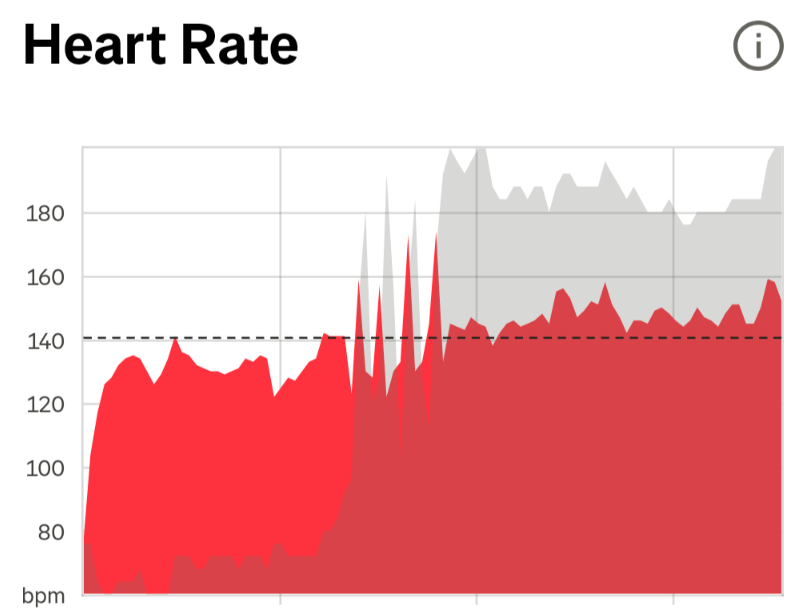
4 x hill repeats “Zone in an athlete with little base aerobic training.
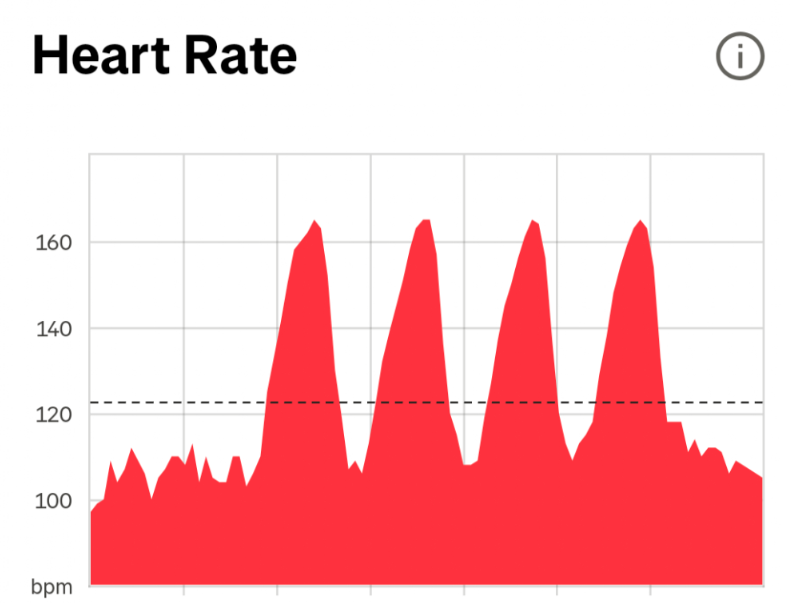
4 x Zone 5 intervals after 5 months of Zone 2 base building
In the tracing on the top, there is very little distinction between moderate and hard effort. The peak heart rate achieaable with max effort is not attainable with even as few as 4 very short Zone 5 intervals. Everything sits in the middle. It is a session full of “kind of hard” work, what we would call mid-zone training. It feels demanding, so it is easy to assume it is improving fitness.
But this is exactly where many people get stuck. They are working hard, without meaningful progress. There is no structure, no real contrast in intensity, and no clear training stimulus.
The tracing on the bottom tells a different story. This is what intervals look like after months of consistent Zone 2 work. There is separation. The low is actually low. The high is truly high. That is the aerobic base in action. It creates space. Space to push intensity when it matters, and space to recover when it does not. The hard efforts here are just as hard, but now they are powerful and targeted. The recovery between them is real, not just slightly less hard. This is what makes the session effective. It is also what makes it sustainable. You can come back the next day and train again, because not everything is sitting in that draining middle ground. Hard sessions are not meant to be an all-out collapse. They are meant to be purposeful. And that only happens when there is a base underneath them. The wider the base, the higher the peak.
The exact same principle applies in strength training, although it is discussed far less clearly. There is a strong push right now for women in midlife to lift heavy. Again, in isolation, that is not wrong. But it assumes that the person has the capacity to make that loading meaningful. That capacity is not just a matter of will or effort. It is built on the ability to move well. To squat without compensating through the spine. To hinge without defaulting to the lower back. To row without everything being taken over by the upper traps. To control position, to access range, and to distribute load across the right tissues.
For many women, especially those coming into structured training later in life, that foundation is not in place. Not because they have done anything wrong, but because of the accumulated effects of years of repetitive patterns, previous injuries, and a lack of exposure to this kind of work. In those cases, the most effective and safest training is not immediately about lifting heavy. It is about building the movement capacity that makes heavier loading possible. And that takes time. Often more time than people expect.
When that process is skipped, and heavier loads are introduced simply because it is what women “should” be doing at this stage of life, the pattern is the same as what you see in that first tracing. The load is there, but the system cannot support it. Movement compensates. Stress shifts to places that are not prepared to handle it. It may feel productive in the moment, but it is not something the body can sustain.
Underlying all of this is a concept that rarely gets discussed outside of more serious training environments, which is training age. Training age has nothing to do with how old you are. It reflects how long, and how well, you have been training in a specific domain. Someone can be highly trained aerobically and still be a complete beginner in the weight room. Someone can be strong and have very little aerobic capacity. The training has to match that reality.
So when you are given advice that is broad, generalized, and based on trends, lift heavy, do HIIT, train this way because you are in perimenopause, it is worth stepping back and asking a more useful question.
Does this actually fit where you are right now? Does it reflect your goals, your experience, and your current capacity? Because in the end, intensity is not what drives progress. It only amplifies what is already there. If the foundation is solid, intensity becomes powerful, precise, and repeatable. If it is not, intensity simply exposes the gaps. And no amount of pushing harder will fix that.
Yours in health,
Tina